Family orientation
Clarify whether the request concerns filtration media, laboratory paper, ReliaFlow sample or conjugate pads, or a medical nonwoven component. Similar fiber language does not make the functions equivalent.
A useful specialty-media review begins with a defined function and ends with a documented decision boundary. The service path organizes available Ahlstrom family and grade information without converting a screening observation into a finished-product approval.
Bring the intended fluid or air stream, assay step, converting route, target format, storage context and any required test method. The response can then distinguish available documentation from data that must be generated during your own qualification.

These lenses prevent a media property, a conversion observation and an end-device requirement from being treated as interchangeable evidence.
Clarify whether the request concerns filtration media, laboratory paper, ReliaFlow sample or conjugate pads, or a medical nonwoven component. Similar fiber language does not make the functions equivalent.
Identify the exact grade and current document. Composition, basis weight, caliper, absorbency, wicking or porosity stay attached to that record and its stated method.
Describe slitting, die cutting, reel handling, pleating, pretreatment or lamination needs. Conversion feasibility remains a manufacturing question, not proof of end-use performance.
List what is still unknown after document review: application exposure, compatibility, device-level performance, regulatory scope or production-lot acceptance.
No customer outcome is asserted here. Each scenario shows the decision sequence a buyer can reproduce with its own samples, methods and acceptance criteria.
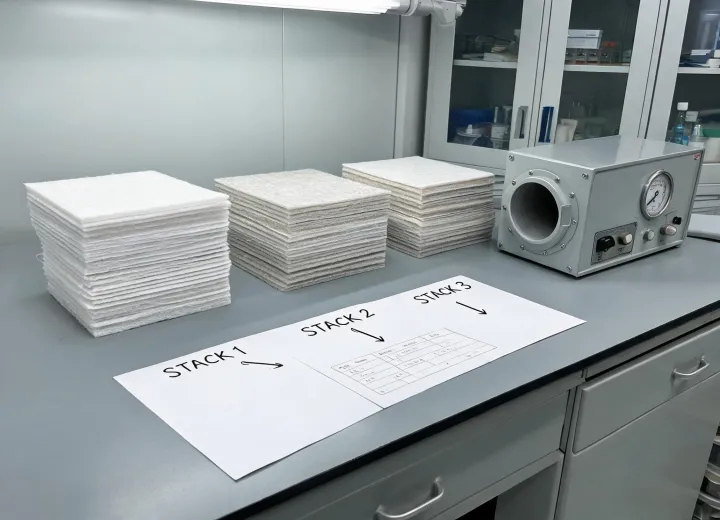
A designer first records the duty, contaminant or particle challenge, target pressure-drop method, operating environment and conversion geometry. A family or grade document may support initial selection, but the pleated element, seal, housing and loading profile can change system behavior. The next step is a controlled prototype test using the buyer's defined method; the medium alone does not guarantee a finished filter result.
For a ReliaFlow sample or conjugate pad, the review captures liquid type, pretreatment, reagent compatibility, target wicking behavior, dispensing route and downstream membrane interface. A grade can be screened for handling and flow, yet assay sensitivity, specificity and diagnostic accuracy belong to the completed design and its validation protocol. Patient or clinical data should never be submitted through a material inquiry.
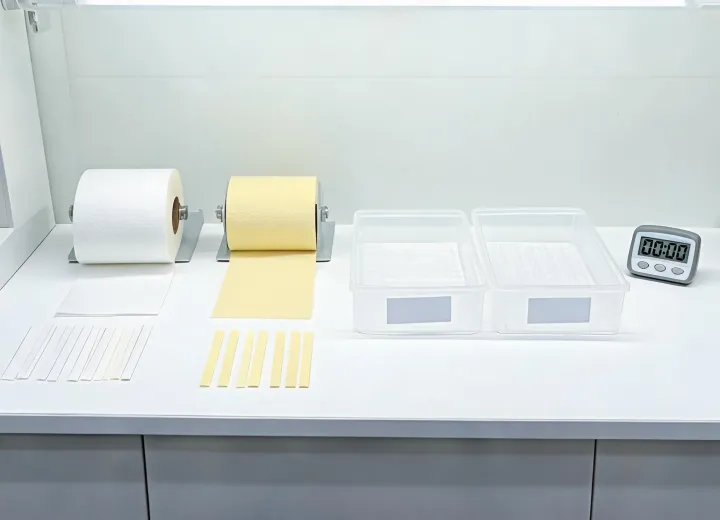
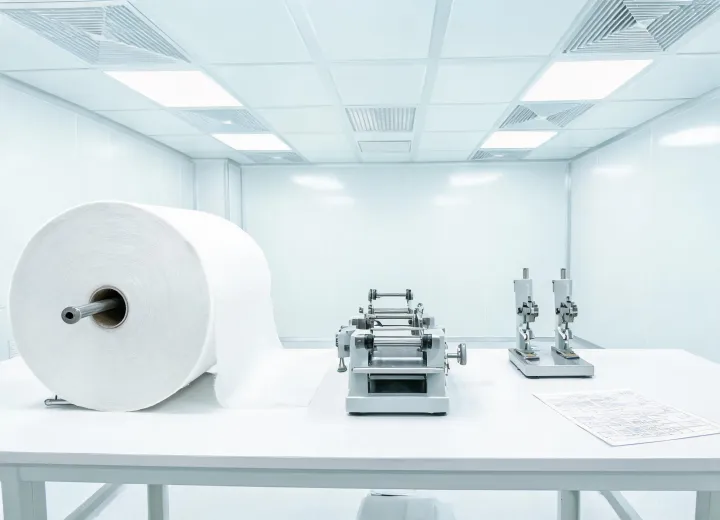
Barrier fabric, sterilization-wrap material and wound-care substrate discussions can address material construction, basis weight, dimensions, converting needs and available test records. The finished device maker remains responsible for design controls, sterilization compatibility, packaging configuration, regulatory classification and intended-use validation. The review therefore marks which evidence belongs to the substrate and which must be established at device level.
Include the application, media role, any candidate family or grade, target dimensions, relevant performance method and the current development stage. If a specification is mandatory, identify the issuing organization, revision and acceptance threshold rather than naming a certification generically.
The inquiry creates a review path; it does not promise stock, sample availability, MOQ, lead time, regulatory acceptance or production performance.