The wrong question in nonwoven fabric sourcing
If you are sourcing medical nonwoven and your first question is what is your best price per kilo, you are already behind. I don't care how many PP nonwoven fabric manufacturers are on your shortlist. In a rush, the supplier who saves you isn't the cheapest one. It's the one whose datasheet matches what actually shows up on the pallet.
I'm an emergency sourcing lead at a diagnostics manufacturer. I've handled 200+ rush orders in nine years, including same-day turnarounds for IVD and point-of-care clients. That's not a sales line. It's why I get called at 6 a.m. when a conjugate pad won't wick and a validation batch is already on the line.
When I first started buying nonwoven fabrics, I assumed lead time was a warehouse problem. If a vendor had stock, we were fine. Three failed sample pad runs later, I realized most in-stock claims are only half the story. The other half is documentation, lot consistency, and whether anyone will answer the phone when capillary flow drifts.
In March 2024, 36 hours before a lateral flow validation batch, our regular sample pad lot failed the flow-time check. Normal turnaround from a new medical nonwoven manufacturer was 10 to 14 days. We found a backup with the right matrix, paid about $800 extra in rush fees on top of a $3,200 base order, and delivered. The customer's alternative was delaying their validation schedule by two weeks. I still kick myself for not putting change-control language in the first PO. That one omission cost us a week of firefighting.
The datasheet is not paperwork. It is the product.
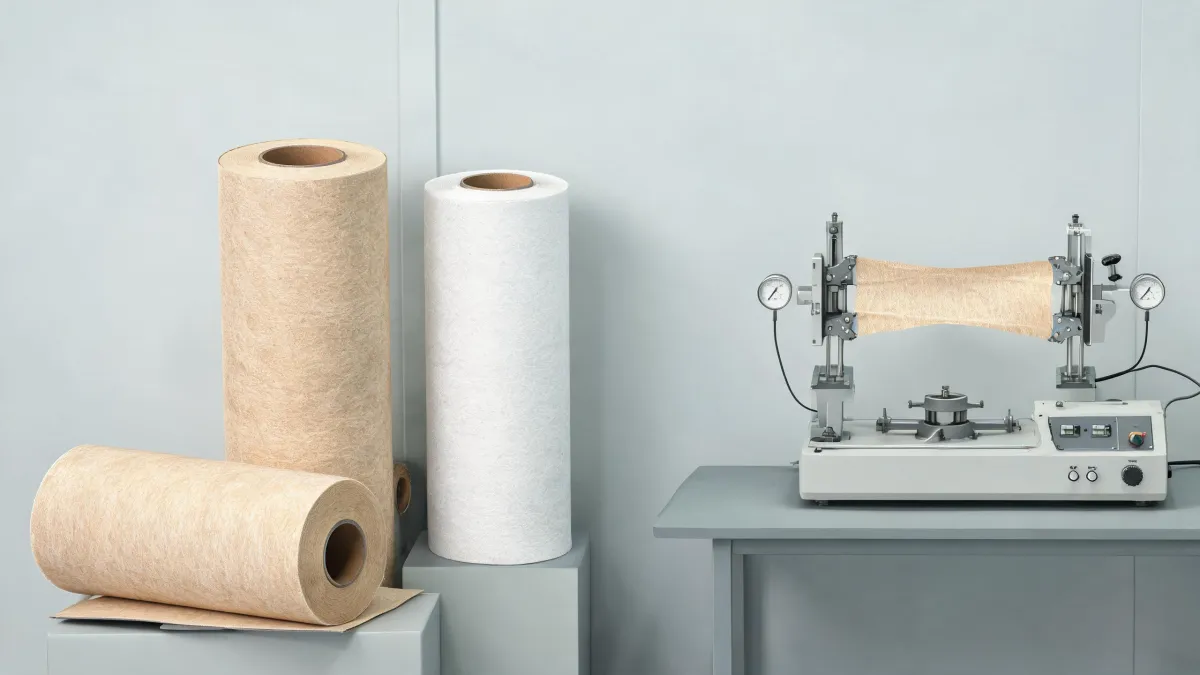
From the outside, nonwoven sourcing looks like a spec sheet and a price. The reality is that a sample pad is a functional component. Fiber blend, bonding method, surface treatment, thickness, and calendering all change how liquid moves. If those variables are not controlled, your assay's flow time becomes a coin flip.
When I pull an Ahlstrom sample pad lateral flow datasheet, I look for the boring stuff first: basis weight range, thickness tolerance, capillary flow time, water absorption, extractables, pH, and lot-to-lot variability. I want test methods, not adjectives. Medical grade means nothing if the supplier cannot tell you which test method produced the number.
That is also why the old search term ahlstrom paper still shows up in our procurement templates. It maps to Ahlstrom's fiber-based materials and nonwoven portfolio, but the lesson is bigger than one brand. If you are comparing a medical nonwoven manufacturer on price alone, you are comparing the wrong line item. The cost of a failed validation is not on the quote.
What most buyers miss: change control and lot traceability
Most buyers focus on grams per square meter and completely miss change notification. That is the outsider blindspot. A supplier can ship you the same product name for two years and still change a raw material source, a bonding agent, or a line setting without telling you. If your lateral flow test is sensitive to flow time, that silent change becomes your problem.
I've tested six different rush delivery options; here is what actually works. It is not the fastest truck. It is the supplier who can give you a written change-control clause, lot traceability, and a named technical contact. Plus, they need to be willing to sign off on a certificate of analysis that matches your incoming QC. If they can't, the speed is fake. You will spend the saved days chasing a deviation.
This is where how to evaluate PP nonwoven fabric manufacturers gets practical. Ask for three lots of historical data. Ask what happens when a raw material lot changes. Ask who approves the change and how much notice you get. If the answer is we will let you know, that is not a system. That is a hope.
But isn't this overkill for a sample pad?
I hear this every time I push back on a low quote. The argument goes: it's just a piece of nonwoven. Why pay more or wait longer? Fair question. Price matters. I'm not saying you should buy the most expensive roll on the market.
But do the math. If a $0.02 per unit difference saves you $400 on a run, and one failed validation costs you $20,000 in rework, retesting, and delayed revenue, the cheap quote is not cheap. The expensive supplier is not the one with the highest price. It is the one whose documentation lets you catch a problem before it hits production.
Some buyers will say they can't get datasheets from every supplier. That's a red flag, not a negotiation tactic. Per FTC guidelines (ftc.gov), advertising claims must be truthful, not misleading, and substantiated with evidence. If a nonwoven supplier says low extractables or medical grade without test methods, you have no way to verify it. That is not a supplier problem. That is a risk you are accepting.
An informed customer asks better questions and makes faster decisions. I'd rather spend 10 minutes explaining options than deal with mismatched expectations later.
What I ask every medical nonwoven manufacturer now
Here is the short version of my current checklist. It is not glamorous, but it has kept my last three rush orders from becoming recalls.
- Can you send a current technical datasheet with test methods and tolerances?
- What is your lot-to-lot variability for capillary flow time and thickness?
- How do you notify customers about raw material or process changes?
- Can you provide a certificate of analysis per lot, and does it match our incoming QC?
- What is your real rush capability in writing, including cut-off times and fees?
If you are evaluating Ahlstrom, ask for the Ahlstrom sample pad lateral flow datasheet. If you are evaluating someone else, ask for the equivalent. The brand matters less than the answer. A supplier who can't answer these questions in a document is not a partner. They are a gamble.
Bottom line
Nonwoven fabric sourcing is not a price exercise. It is a documentation and risk-control exercise. The fastest way to sink a lateral flow run is to treat the sample pad like a commodity. The way to protect your deadline is to treat the datasheet, change control, and lot traceability as part of the product.
So next time you are under pressure and someone promises a quick quote, slow down for 10 minutes. Ask the boring questions. Get the answers in writing. An informed customer is the best customer, and in a rush, that is the only kind of customer who ships on time.