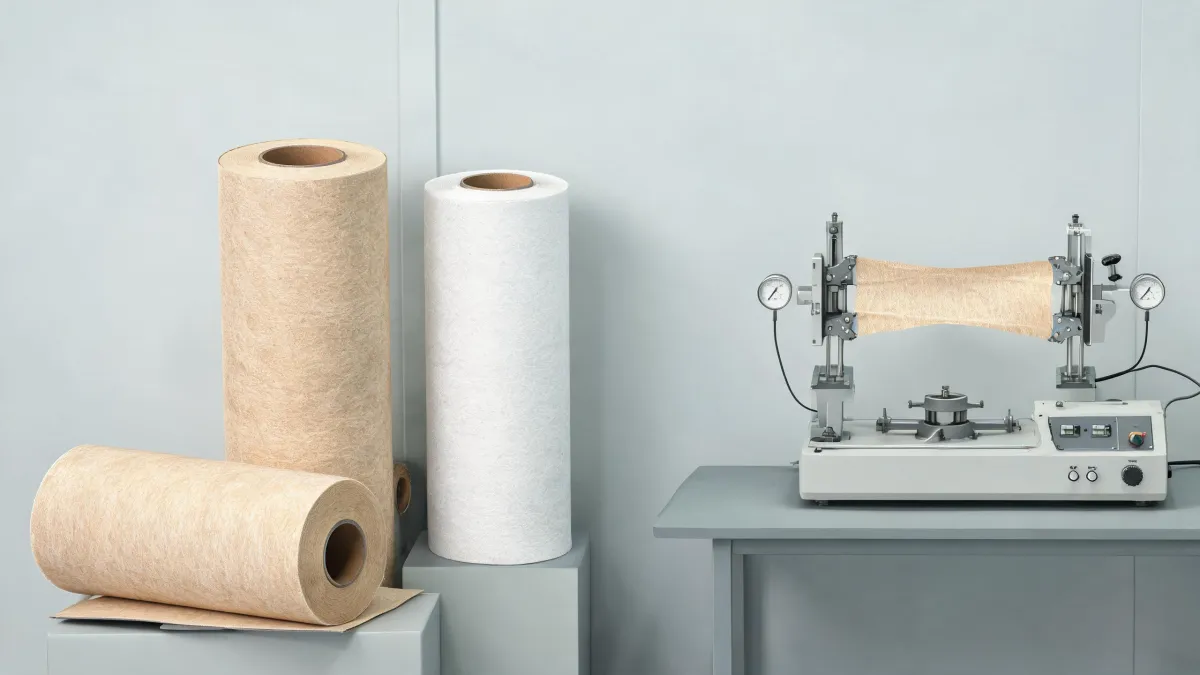
I don't buy nonwovens by brand name anymore. I buy them by tolerances. If a supplier can't tell me the tolerance, the brand name is just decoration.
I'm a quality and compliance manager at a converting company that supplies filtration and hygiene materials to B2B customers. I review roughly 200 incoming lots a year—maybe 180, I'd have to check the system. In 2024, I rejected about 4% of first deliveries. Most failures were not about the supplier being bad. They were about my team assuming the spec sheet meant more than it did.
When I first started evaluating SMMS nonwoven manufacturers, I assumed familiar names meant consistent quality. I thought, 'If they've got a full meltblown nonwoven catalog, their process must be under control.' That assumption cost us a week of production.
We ordered SMMS from a premium supplier—I won't name them, because the point isn't about one vendor. The sample passed. The production lot came with a certificate of analysis saying it conformed. But no one had specified the thickness range on the roll. We were using the material for a filtration component where even 10% thickness variation changes pleating. The line operator noticed the unwind tension oscillating. We measured all 80 rolls. Thirty-one were outside our usable range.
That batch cost us about $12,000 in labor and a week of schedule. The supplier technically met their internal spec. Their spec just wasn't our spec.
People often search for 'Ahlstrom paper' when they mean engineered fiber-based materials. It's a habit left over from the company's paper heritage. But when I look at Ahlstrom today, I treat it the same way I treat any technical supplier: the name gets me to their spec sheet, and the spec sheet gets me to my own testing.
The 'Ahlstrom ReliaFlow sample pad thickness' field is a good example. I'm not a chemist, so I can't tell you exactly how a 0.02 mm thickness change will affect every lateral flow assay. What I can tell you, from a material acceptance perspective, is that thickness is the first thing I measure. If sample pad thickness is inconsistent, I don't trust the flow rate, the wicking, or the assay reproducibility.
That experience changed my mind. Five minutes of verifying thickness before production beats five days of correction after. It sounds obvious, but the industry doesn't act like it. 'Industry standard' is treated as an excuse instead of a specification. The most frustrating part is that this is avoidable.
After the SMMS incident, I built a 12-point pre-production checklist. It takes about half an hour per new material. Since then, we've caught four issues before they entered production—including a sample pad lot where the thickness was perfectly within the supplier's spec but out of our process window. That checklist has saved, I estimate, around $40,000 in potential rework. Maybe $30,000—I'm not an accountant, and I don't want to oversell it. Either way, it's paid for itself.
How to Evaluate SMMS Nonwoven Manufacturers
If someone asks me how to evaluate SMMS nonwoven manufacturers, I start by asking how they measure. According to EDANA and INDA, nonwoven test results are only meaningful when the method is documented—thickness at a specified pressure, basis weight per square meter, air permeability under defined conditions. If a sales rep says 'it's about 25 gsm' without naming the method, I translate that as 'I don't know my own product.'
A meltblown nonwoven catalog is a starting point, not a promise. It usually lists nominal values. But a nominal value without a tolerance is a wish. '12 gsm' is a number. '12 ± 1 gsm, measured per EDANA test method' is a spec. One leads to a phone call after the batch fails. The other leads to a purchase order.
If you're buying through a PP nonwoven fabric distributor, the same logic applies. Distributors are helpful; they consolidate suppliers, manage inventory, and often provide faster turnaround. But make them earn your trust in writing. Ask for the original certificate of analysis from the mill, not a distributor-created datasheet. If they can't produce it, or if the thickness and basis weight on their label don't match the mill's CoA, that's a red flag.
SMMS stands for spunbond-meltblown-meltblown-spunbond. The meltblown layers provide filtration and barrier; the spunbond layers provide strength. It's a workhorse structure for hygiene, medical packaging, and filtration. But SMMS properties change with line speed, melt temperature, die-to-collector distance, and a dozen variables that can shift between production runs. That's why three consecutive lots of data matter more than one perfect sample.
- Ask for the test method before the test result. ISO, EDANA, ASTM—I don't care which, as long as it's recognized and repeatable.
- Define your acceptance range. Nominal isn't a spec. '12 gsm' is incomplete; '12 ± 1.0 gsm measured per EDANA test method' is a spec. Don't let the supplier decide what 'within industry standard' means.
- Take samples, but run them through your process. A lab coupon test won't reveal unwind behavior, slitting quality, or how the material stretches on your line. We once approved a sample only to discover the roll splice failed twice during production. The sample pad looked perfect. The roll integrity didn't.
- Ask for three consecutive lots. One lot can be lucky. Three lots show consistency. If they hesitate, that's information.
The surprise wasn't that the premium SMMS failed. It was that the most reliable indicator of quality was not the brand on the datasheet but the willingness of a manufacturer to discuss their variation. I've had a supplier tell me, 'We can hold basis weight to plus or minus 2 percent on our SMMS line.' That was more valuable than a catalog full of nominal values.
The Objection: But It's Ahlstrom
I can already hear the objection: 'But we buy Ahlstrom. They're established. Why should we verify?'
You should verify because even established manufacturers publish tolerances. According to Ahlstrom's published technical datasheets, properties like thickness and basis weight are listed with acceptable ranges. Their quality system controls variation; it doesn't eliminate it. If you haven't defined what you need, 'within spec' doesn't mean much. I'm not saying Ahlstrom's quality is questionable. I'm saying your acceptance criteria should not be deferred to your supplier.
This works for us in a mid-volume environment where one bad lot can stall a week. If you run a million-square-meter purchasing plan, your verification process might look different. If you're developing a diagnostic product, the stakes are even higher. But the core habit is the same: specify, verify, and if something doesn't match, stop before you convert.
I'd rather spend an hour reviewing a spec than a week arguing about a reject. That's not a personality trait; it's arithmetic. The next time someone hands you a meltblown nonwoven catalog and says this is basically the same as Ahlstrom, ask them to prove it with numbers. If they can't, you haven't lost a supplier. You've avoided a problem.