-
1. What is “Ahlstrom paper”? Is it actually paper?
-
2. Where do I find the Ahlstrom 8964 sample pad datasheet, and what should I check in it?
-
3. How do I evaluate non woven fabric wholesale suppliers without getting burned?
-
4. What should I look for in a meltblown nonwoven supplier?
-
5. PET nonwoven fabric wholesale cost guide: what's driving prices in 2025?
-
6. Is paying extra for a guaranteed delivery date worth it?
-
7. How far ahead should I order Ahlstrom or custom nonwoven materials?
-
8. Does Ahlstrom support OEM or private label orders?
I've been the person who buys nonwoven fabric, filter material, and Ahlstrom specialty papers for my company since 2020. I manage the purchase orders, the vendors, and the occasional fire drill when a production date gets moved up. This FAQ is basically the list of questions I wish I'd had answered when I started, plus the ones new colleagues and suppliers ask me now.
Here's what this page covers:
- What “Ahlstrom paper” actually is
- Where to get the Ahlstrom 8964 sample pad datasheet and what to check on it
- How to evaluate non woven fabric wholesale suppliers
- What to look for in a meltblown nonwoven supplier
- What drives PET nonwoven fabric wholesale cost in 2025
- Whether paying for a guaranteed delivery date is worth it
- How far ahead to order critical grades
- Whether Ahlstrom supports OEM or private label
1. What is “Ahlstrom paper”? Is it actually paper?
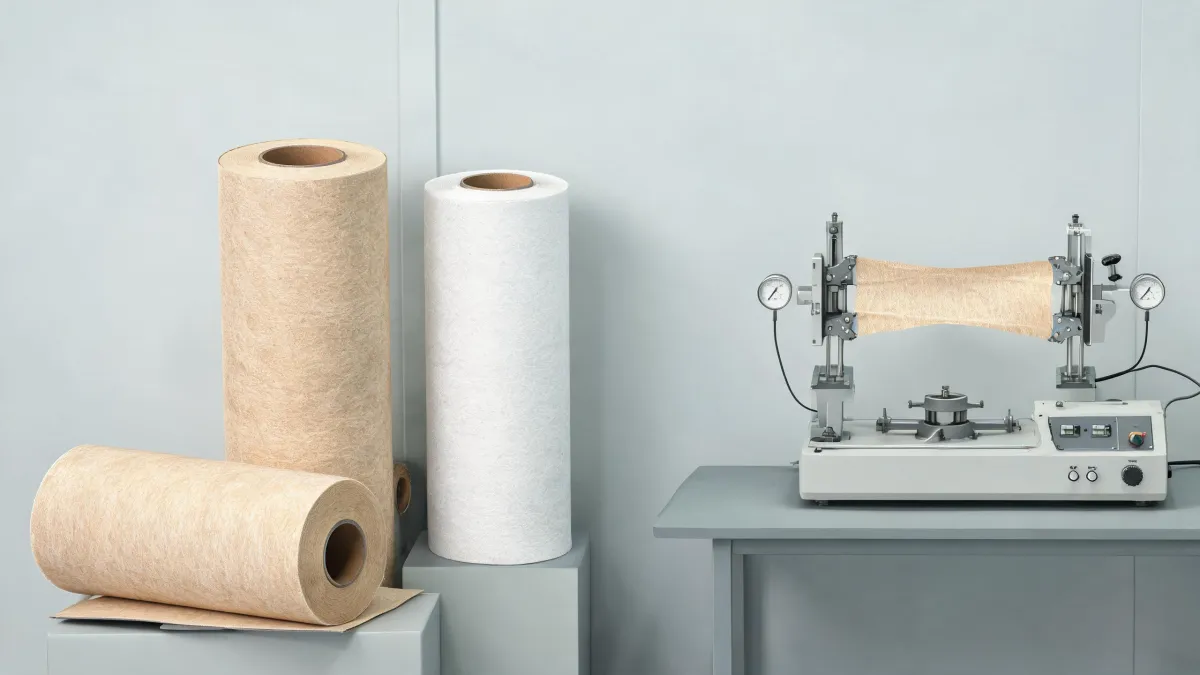
Sort of, but not the way most buyers expect. Ahlstrom makes fiber-based materials: nonwoven fabrics, specialty papers, filtration media, and medical materials. Some of it looks and handles like paper; a lot of it doesn't. When I say “Ahlstrom paper,” I'm usually talking about technical grades like sample pads, conjugate pads, and filter media sold in rolls or sheets.
The important difference for buyers: Ahlstrom technical materials are specified in grams per square meter (gsm), not in office-paper weights. For context, standard copy paper is 75 gsm (20 lb bond). A grade like the Ahlstrom 8964 sample pad is a much lighter, engineered material with a specific fluid-handling job. If a supplier quotes you “Ahlstrom paper” without a grade number and a basis weight, that's a red flag.
2. Where do I find the Ahlstrom 8964 sample pad datasheet, and what should I check in it?
The current datasheet comes from Ahlstrom's product pages or from an authorized distributor. I always ask for the latest revision — datasheets do get updated, and I learned that the hard way when our R&D person caught an old revision in our files (twice, unfortunately).
As a buyer, I look for three things:
- The exact grade and part number (8964 is one grade in a family, and roll width matters to your converting line)
- Basis weight and thickness in the latest revision
- Storage and handling conditions, plus lot traceability on the certificate of analysis
I also check the packaging before accepting a delivery. Fibrous materials can be damaged by moisture and look perfectly fine until you unroll them. I won't pretend to recite the capillary rise specs from memory — that's what the datasheet is for. But I do not let a new material into production without that document on file.
3. How do I evaluate non woven fabric wholesale suppliers without getting burned?
I evaluate non woven fabric wholesale suppliers the same way I evaluate any vendor: documents, consistency, and follow-through. Ask for the exact grade and part number, not just “nonwoven.” Get a technical datasheet and an SDS before you commit. Confirm the MOQ, the lead time, and whether that lead time is a commitment or a hopeful estimate. Then order a small quantity first.
The easiest way to get burned is an unlabeled “compatible” material that looks like an Ahlstrom grade but behaves differently. It might be fine — or it might have a different wetting profile and ruin your process.
Another hard lesson: verify invoicing before you order. In 2022, a new supplier quoted $300 less per roll than our regular source. I ordered three rolls. They couldn't produce a proper invoice — handwritten receipt only. Finance rejected the expense report, and I ate $900 out of the department budget. Now I confirm a supplier can produce clean, correct paperwork before any PO goes out.
If you're private-labeling, agree on label color tolerance before production. Brand-critical colors should be within Delta E < 2; once a label color is visibly off, end customers notice.
4. What should I look for in a meltblown nonwoven supplier?
Meltblown is a material where the lowest quote can be the most expensive purchase you'll make. The key specs are basis weight consistency, fiber uniformity, filtration performance (if that's your application), roll width and length, and packaging. If you're buying for medical or filtration use, ask for certifications, cleanliness documentation, and lot-level traceability upfront — not after the order is placed.
Meltblown suppliers get swamped during supply disruptions, and that's when lead times stretch and rush fees appear out of nowhere. If you wait until the last minute, you're gonna pay for it twice: higher price and longer lead time.
Honestly, I'm not sure why rush premiums vary so much between suppliers. My best guess is it's more art than science. What I do know: when two suppliers are close on price, I pick the one that will confirm a date and hit it. A “probably on time” promise is too risky when a production line is waiting.
5. PET nonwoven fabric wholesale cost guide: what's driving prices in 2025?
As of January 2025, the biggest line item in PET nonwoven quotes is still the raw material. PET resin prices track oil, energy, and recycled PET markets, so a quote from Q4 2024 can be stale by the time it reaches your desk. That's why I ask every supplier to put a validity window on written quotes.
After resin, the main cost drivers are fiber fineness (microdenier fibers cost more to produce), basis weight and fabric density, finish treatments like hydrophilic or antistatic coatings, and freight — which can swing landed cost noticeably.
I won't give you a single “typical” price per square meter, because anyone who does is guessing. Our own PET nonwoven wholesale quotes last year varied a ton depending on spec and volume. Budget a range, lock in lead times, and confirm whether the price is fixed or subject to resin surcharges. That last point caught me off guard once; now it's the first question I ask.
6. Is paying extra for a guaranteed delivery date worth it?
If you'd asked me in 2021, I'd have said no. Then in 2023, we had a production line waiting on a nonwoven order. Our usual distributor offered a fixed delivery date for an extra $350; another supplier was cheaper and “pretty sure” it would arrive on time. With our ops manager standing at my desk, I had two hours to decide. Normally I'd compare multiple quotes side by side. There was no time, so I went with the guaranteed slot based on trust alone.
The order arrived on time. The cheaper supplier's shipment showed up a week later (on a different line, thankfully).
Since then, when a date truly matters, I build the premium into the budget before I issue the PO, not after. In March 2024, we paid $400 extra to guarantee a production slot in an emergency. The alternative was missing a shipment to our own customer, which would've cost us way more. The fee buys certainty, not just speed. Uncertain cheap is more expensive than certain expensive.
7. How far ahead should I order Ahlstrom or custom nonwoven materials?
For standard Ahlstrom grades, I never assume a distributor has stock, even though they usually do. I order three to four weeks ahead for routine needs. Custom nonwoven orders — custom width, custom coating, private label — typically run six to ten weeks depending on the supplier's production schedule.
If you think you might need materials in a rush, the time to tell your supplier is before the rush exists, not after. That's the biggest lesson from 2021, when we scrambled for meltblown along with everyone else: good relationships and confirmed dates don't happen at the last minute. We now keep a small buffer stock of critical grades flagged in our inventory, and it's saved us twice.
8. Does Ahlstrom support OEM or private label orders?
Yes — this was one reason we moved more volume to Ahlstrom grades in our 2024 vendor consolidation project (we cut our supply base from 12 vendors to 4). We private-label some finished filter products, so we need suppliers who hold specs and keep branding clean. Confirm the exact grade, roll size, core labeling, and case marking, and get confirmation in writing that the material can be resold under your brand.
Also ask whether there's a technical contact for when things behave oddly. It sounds obvious, but a supplier who answers process questions quickly has saved us from guessing more than once. That kind of support is way easier to rely on than a static datasheet.