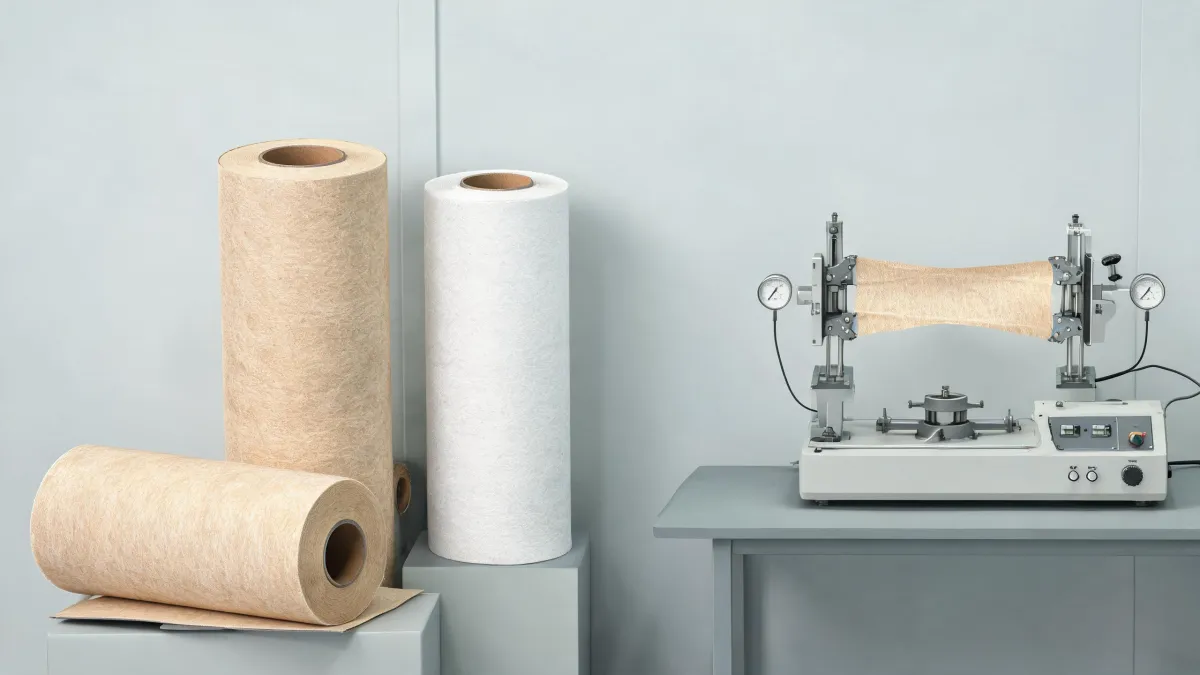
I'm going to say something that might make some procurement professionals uncomfortable: the way most of us evaluate nonwoven materials is outdated. Not slightly. Not "we could optimize." I'm talking fundamentally outdated. And I'm saying it as someone who personally cost his company $9,800 and nine days of production time to learn this lesson.
I've handled material sourcing for medical device and diagnostic manufacturers for about eight years. The unglamorous part of the industry—thickness tolerances, lot-to-lot variation, test method discrepancies. In that time, I've made and documented 27 significant purchasing mistakes, totaling roughly $38,000 in wasted budget. Some were rookie errors. The expensive ones came from assuming the industry worked the way it did when I started.
The nonwoven industry has evolved more in the last five years than in the previous twenty. Most procurement teams are still evaluating materials using methods from 2019.
The Ahlstrom 8964 Thickness Lesson
In June 2024, we needed to order Ahlstrom paper grade 8964—a substrate used in a lateral flow diagnostic component. Our engineering team specified a target thickness range based on an older datasheet. I placed the order with a supplier we'd used for years. When the certificate of analysis arrived, the thickness was listed as technically in-spec. Good enough, I thought. We released it to production.
What I didn't know: Ahlstrom had updated the technical datasheet for 8964 two quarters earlier. The new spec included tighter thickness tolerances and a revised test protocol—30 mm pressure foot diameter at 0.5 kPa, instead of the older procedure we were still referencing. Our "in-spec" material was actually out of spec for the current manufacturing requirement.
The converting line ran for four hours before QC flagged it. 1,200 scrapped components. A 9-day delay while we expedited replacement material. A rush-order invoice that made the original price look like a bargain.
Here's a detail I haven't talked about much: when we discovered the issue, I had roughly two hours to decide how to respond. Normally I'd run a cost-benefit comparison, get multiple quotes, and escalate for approval. There wasn't time for that. I made the call to expedite production based on a gut feeling and one phone call to a sales rep who happened to answer. In hindsight, I should have pushed back on the timeline and demanded a proper cost breakdown. But with production halted and senior leadership asking for a recovery plan, I did the best I could with incomplete information. The expedite fee alone was $2,300.
The mistake wasn't the supplier's. It was mine. I was working from yesterday's data in a market that had moved on.
Single-Point Specs Are No Longer Enough
What surprised me most when I started investigating: the thickness value on most nonwoven and paper materials—including Ahlstrom 8964—isn't one number. It's a distribution.
When a datasheet says nominal thickness of 0.35 mm, that's typically an average from a specific test method under controlled conditions. The actual material varies across the web width, along the roll length, and between lots. That's always been true. What's changed is the downstream requirement.
In lateral flow diagnostics, a few percent deviation in thickness affects capillary flow time, which affects assay performance. In hygiene products, thickness uniformity affects absorbency distribution and skin comfort. In medical packaging, it affects seal integrity. Older manufacturing processes could absorb some of that variation. Modern lines—faster, tighter tolerances, automated QC—can't.
According to ISO 9073-2, the standard method for nonwoven thickness measurement, test parameters like pressure foot area, applied pressure, and measurement time can produce statistically different readings on the identical material. A material that reads 0.35 mm under one protocol might read 0.33 mm or 0.38 mm under another. (Source: ISO 9073-2. Verify current version for your specific application.)
Most datasheets don't prominently display these parameters. Unless you know to ask, you might be comparing apples to oranges across suppliers. I didn't know this in year three. I didn't know it in year five. It took an expensive rejection in 2024 to make me realize that a number on a datasheet is a claim, not a guarantee.
The Price-Per-Roll Trap
The second outdated habit: comparing materials on unit price alone.
Let me share a specific example. In early 2024, I approved a hygiene nonwoven purchase from an alternate supplier at roughly 11% lower cost per unit than the Ahlstrom equivalent. The annualized savings across four SKUs looked like about $47,000. Qualification passed. Test results were fine. Then we ran it in volume.
The first two weeks were fine. Around week three, we received a lot with notably higher variability in basis weight and thickness. Line speeds dropped about 9% to avoid quality issues. Scrap increased. QC sampling intensity doubled. The "savings" evaporated, absorbed by reduced throughput and hidden quality costs. Then one lot actually failed gauge checks, costing 15 hours of downtime and a customer expedite fee.
I have mixed feelings about this in hindsight. Part of me wants to defend the decision—the initial qualification data genuinely looked acceptable. Another part knows I was comparing two materials as if they were interchangeable commodities. They aren't.
The industry has evolved to a point where nonwoven materials are engineered, not just manufactured. Ahlstrom doesn't price medical-grade materials at commodity levels without reason. Lot-to-lot consistency, documentation, traceability, technical support—these have real value that shows up on the production floor, not on the purchase order.
After that episode, I built a total cost of ownership checklist that accounts for unit price, line speed impact, scrap rate, QC sampling cost, and the cost of a potential line stoppage. We've used this framework for the past 18 months and caught 14 potential sourcing traps. Avoiding just two of those events paid for the entire exercise.
If someone hands you a hygiene nonwoven wholesale cost guide that doesn't mention these factors, treat it as incomplete. Price per unit is the starting point, not the conclusion.
"But We've Used the Same Supplier for Years"
Let me address the objection I hear constantly: "We've bought from the same nonwoven fabric supplier for ten years, and it's been fine."
I respect that position. Long-term relationships have genuine value. During the supply chain crisis in 2022, our long-standing relationship with Ahlstrom was one of the reasons we received allocation when others couldn't. The fundamentals of vendor relationships—trust, communication, mutual commitment—haven't changed.
But the execution has transformed. In 2025, a relationship alone isn't sufficient if your engineering team references updated standards and your customers demand stricter quality documentation. Suppliers update manufacturing processes, reformulate grades, and modify test protocols without sending press releases. That's not deception. It's just an industry moving forward.
We now do an annual spec review with every critical supplier. Not a contract renewal—an actual spec verification. We re-confirm the test methods behind every quoted number and check whether any standards have been updated. This process has already caught two significant discontinuities that would likely have become line-down events.
There's something satisfying about that. After years of reacting to surprises, finally being ahead of them? That's the payoff.
What I Still Believe
For all this talk of evolution, some fundamentals remain. Quality documentation matters. In ISO 13485 environments, suppliers who provide traceability and validation support are not replaceable. Total cost analysis is only as good as the inputs. And when problems arise, having a contact who picks up the phone is worth more than any contract clause.
I'm not advocating that you abandon trusted suppliers or chase the newest technology. That would be foolish. But I am saying the industry has changed, and the speed of change is accelerating. The materials available today are not the materials from 2015. Test methods have been refined. Manufacturing tolerances have tightened. And the cost of using outdated information is higher than ever because downstream processes run faster and forgiving margins have shrunk.
The question isn't whether your supplier is good enough. It's whether your evaluation framework is current enough.
Had I asked that question before the Ahlstrom 8964 order in June 2024, I'd have saved $9,800 and nine days. I've already paid for that lesson. If you're still evaluating nonwoven suppliers the way you did in 2019, there's a similar invoice waiting for you. That's not a prediction. It's a pattern.