The Problem You Think You Have
You need SSSS nonwoven fabric for a medical or filtration product. You contact a few suppliers, get quotes, pick the one with the best price and lead time, and place the order.
Then the shipment arrives. Something's off. Maybe the material feels different. Maybe the filtration efficiency doesn't meet spec. Maybe your production line rejects it during incoming QC.
You think the problem is: I picked the wrong supplier.
Most of the time, that's not the actual problem.
The Deeper Issue: What Your Supplier Doesn't Know to Tell You
Here's what I've learned after years of sourcing nonwoven materials for medical and diagnostic products.
When you're evaluating SSSS nonwoven wholesale options, the quote sheet usually looks something like this:
- Material type: SSSS
- Weight: 30 gsm
- Width: 160 cm
- Price: $X per kg
- Lead time: 4-6 weeks
What it doesn't list: fiber diameter, bonding method, tensile strength, elongation at break, air permeability, surface treatment, or batch-to-batch consistency range.
Those omissions are where things go wrong.
1. "SSSS" Only Describes the Structure, Not the Performance
SSSS means spunbond-spunbond-spunbond-spunbond — four layers of spunbond nonwoven. That's it. Within that structure, you can have massive variation in basis weight, fiber diameter, bonding method (thermal, chemical, or mechanical), and additives.
Two suppliers can both legally sell you "SSSS nonwoven" that behaves completely differently in your production process.
I used to think it was like buying standard copy paper — just pick a weight and you're done. This was true maybe 15 years ago when SSSS was primarily used for basic disposable items. Today, with nonwovens feeding into filtration media, diagnostic consumables, and wound care products, the performance envelope has tightened considerably. That old mental model will cost you.
2. Your Quote Sheet Is a Marketing Document
I had a situation a while back. We switched suppliers because our previous one raised prices. The new supplier sent samples; they performed identically in lab tests. We placed a bulk order.
The first batch was fine. The second batch had a roughly 15% deviation in basis weight. The third batch had a different fiber diameter — and we didn't catch it until after 20,000 diagnostic test strips had passed through the line.
The supplier wasn't malicious. They simply shipped what their process produced, and we hadn't specified — in writing — what we actually needed beyond "30 gsm SSSS."
Their idea of 30 gsm and ours were about 12% apart. Both within "normal" manufacturing tolerance, both technically compliant with the quote sheet, but different enough to cause real problems downstream.
3. Communication Gaps That Don't Show Up Until It's Too Late
Two examples.
First: I said "medical-grade nonwoven." They heard "nonwoven suitable for medical use." I meant ISO 13485 certified, with ISO 10993 biocompatibility testing. They meant "meets basic hygiene standards." The gap between those two interpretations only became clear when we requested regulatory documentation for our own submission.
Second: we once specified a conjugate pad thickness by referencing a Ahlstrom 8950 conjugate pad thickness equivalent — roughly 0.35 mm. The supplier quoted a material that measured within ±0.02 mm. Technically accurate. But our assembly equipment had been calibrated for that reference material, and the tolerance stack worked out to a 4% rejection rate at final QC. Nobody's fault, but the cost was ours.
What This Actually Costs You
The obvious costs are quality rejects and production downtime. But the expensive part is usually downstream.
Batch inconsistency is the silent killer. If your line is calibrated for one material and the next shipment deviates by 15% in basis weight, your throughput drops before anyone realizes why. The last time this happened to us, we lost about three days of production. That's not a quality problem — it's a process variation problem, and it's harder to diagnose because nothing is technically "defective."
Recall risk is the catastrophic scenario. In medical nonwoven private label products, if filtration efficiency or barrier performance doesn't meet the declared spec, you're looking at a potential recall. I've been close enough to one to know that the direct cost is only part of the story. The customer confidence hit lasts longer than the invoices do.
And I don't have hard data on industry-wide nonwoven quality incident rates, but based on our own procurement history over five years, my sense is that roughly 8–12% of first deliveries from a new supplier have some issue that requires renegotiation, sorting, or return. That's a rough estimate from a sample of maybe 40-50 orders, not a benchmark — but it's consistent enough that I plan for it now.
How to Actually Choose SSSS Nonwoven for Wholesale
After enough iterations (and enough mistakes), here's what I've settled on:
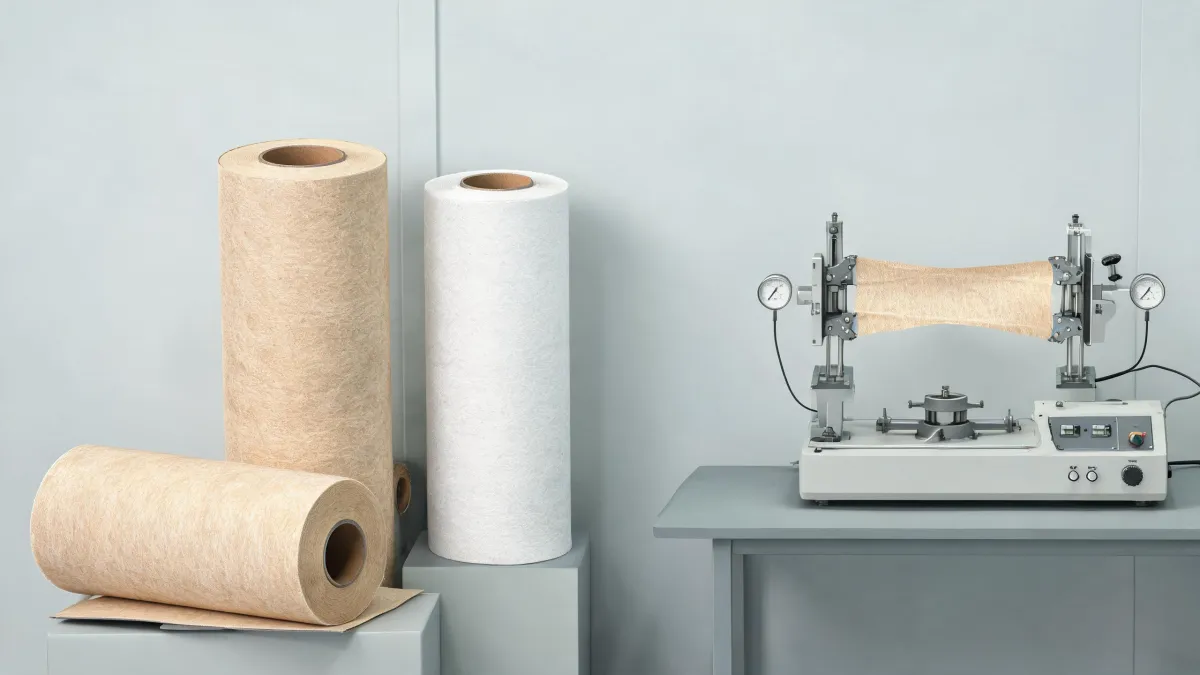
Write a performance spec, not a material description. Don't just say "SSSS, 30 gsm." Specify tensile strength (MD and CD), elongation, air permeability (for filtration), thickness range, and bonding method. If you don't know what matters for your application, ask your production team — they'll tell you exactly which parameters cause headaches.
Require batch-level test reports. Not just a certificate of analysis for the sample. Every shipment. If a supplier can't or won't provide this, that tells you something about how they run their process.
Do a line trial, not just a lab test. The material that performs perfectly in a bench test can behave differently at production speed, under tension, or with your specific equipment. Run a small batch before committing.
Don't optimize for price alone. When you're sourcing medical nonwoven private label materials, the cost of a batch failure is almost always higher than the per-unit savings from choosing the cheapest supplier.
When This Approach Doesn't Apply
I should mention: if you're buying small quantities for non-critical applications — say, general-purpose disposable items where a bad batch means a minor inconvenience — then a lot of this is overkill. My experience is based on medical and diagnostic nonwoven sourcing, where the stakes are higher. If your application is more forgiving, you don't need to run every one of these checks.
Also, my perspective comes from a mid-sized company with maybe 40-50 nonwoven purchasing cycles under my belt. If you're a large OEM with dedicated materials engineering teams, you probably have more sophisticated processes than what I've described here.
The point isn't to be perfect. It's to close the gap between what you think you're buying and what actually shows up at your dock. That gap is where the real costs hide.