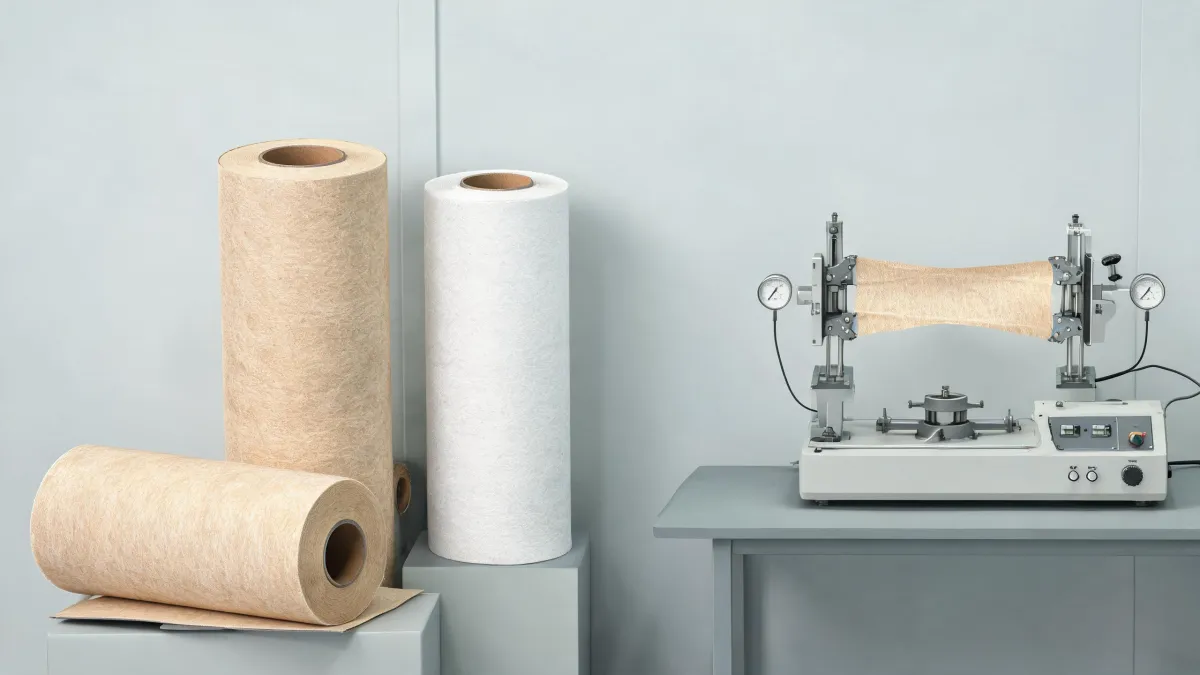
I've handled more than a few rush nonwoven orders where the client needed answers in hours, not weeks. Some ended well. Some were learning experiences. And the biggest lesson? There's no single playbook for buying nonwoven roll goods. Your decision depends on the situation.
Over time, most nonwoven purchases fall into one of three scenarios. Once you know which one you're in, you can stop searching for a universal answer and start making a practical call.
Start With Your Nonwoven Scenario
These three scenarios cover most procurement paths I've seen:
- Scenario A: You have a branded specification like Ahlstrom 8964 thickness and need to source that grade without uncertainty.
- Scenario B: You're buying commodity PP nonwoven fabric for a general end use and need a reliable distributor.
- Scenario C: You're launching or expanding a PET nonwoven product line and must decide between OEM manufacturing and private label.
Notice something? What works for one buyer completely backfires for another. Let's walk through each scenario and what I'd actually do in it.
Scenario A: When the Branded Specification Matters
Suppose your customer asks for Ahlstrom paper, or your internal spec says "Ahlstrom 8964 thickness." Chances are you aren't just looking for any nonwoven. You're looking for a specific grade with a known technical data sheet.
The fastest route here is usually a certified distributor who keeps stock and can produce the official spec sheet on request. They have the traceability you need, especially if you're in a regulated field like IVD or filtration. Going direct to a factory might sound more official, but it's often slower and less practical for a time-sensitive order.
Here's a mistake I made once: we accepted a "comparable grade" from a discount supplier to save about 12% on a PP nonwoven order. The savings disappeared after we verified the thickness variation and had to reorder with rush fees. The comparison grade might have worked in another application. It didn't work for ours.
When time is tight, the premium you pay to a distributor for branded Ahlstrom material isn't just for the product. It's for the certainty that the spec you receive is the spec you need.
Most buyers who search for "Ahlstrom 8964 thickness" are trying to lock down a technical detail before approving a batch. Don't rely on a verbal answer from a sales rep. Ask for the official thickness test data or the datasheet reference. If the seller puts a vague number in an email without supporting documentation, treat that as a red flag—especially if you're under deadline pressure. In this scenario, documentation is more valuable than shipping speed.
Emergency pick for Scenario A
If you have less than a week to lock in material, start with an established Ahlstrom distributor that carries the exact grade. Paying a small premium for confirmed specs is cheaper than a failed batch. Plain and simple.
Scenario B: Commodity PP Nonwoven Fabric and the Distributor's Role
PP nonwoven fabric is about as close to a commodity as nonwovens get. Used in packaging, hygiene components, industrial wipes, and protective apparel, it's available in many widths, weights, and colors. If you don't have a strict brand grade in mind, you're probably trying to find the balance between cost, lead time, and consistency.
Here's the thing: a PP nonwoven fabric distributor often has an advantage over buying direct from a mill. Distributors aggregate capacity from multiple manufacturers and usually have stock on hand. For general-purpose use, you don't need a specific Ahlstrom grade; you need nonwoven that works and arrives when promised.
Work with distributors that publish or share data on basis weight, roll width, and splice counts. Ask for the manufacturing date and verify the roll's weight on arrival. It sounds basic, but I've seen good production lines come to a halt because a set of rolls had inconsistent caliper across the width. The distributor wasn't the problem; the screening process was too loose.
To be fair, going direct to a factory can save money on large volume. But when you need urgency and consistent stock, a distributor often performs better. You pay a premium for the reliability of holding inventory and pre-qualifying production lots. That's not markup waste; that's time certainty.
The key measurement for a commodity PP purchase isn't just price per kilogram. It's the total cost of getting a usable batch to your line without stopping production.
Scenario C: PET Nonwoven Fabric OEM vs Private Label
PET nonwoven is a different beast. It can handle higher temperatures, offer chemical resistance, and deliver better dimensional stability. When a manufacturer or brand owner asks me about "PET nonwoven fabric OEM vs private label," they're usually trying to work out who should own the brand and who should own the specs.
If you work with an OEM manufacturer, the material is made to your specifications or your original design. If you go private label, you're essentially putting your label on the manufacturer's standard product without changing the spec. These are completely different procurement decisions.
Which one is better? It depends on your roadmap:
- OEM makes sense when you need control over basis weight, finish, or customized roll formats. You get flexibility—but you also take on qualification cost and minimum order requirements.
- Private label makes sense when you want speed and simplicity. You choose an existing grade, put your brand on it, and spend your time on sales instead of R&D.
One thing I've learned the hard way: never assume "close enough" on the datasheet means the same performance. In 2024, I watched a team assume a private label PET nonwoven would match the OEM product they had been using because the thickness values were similar. It wasn't until the material hit the production line that the difference showed up. The calibration profiles changed, and the line had to be adjusted. The specification gap cost more than any savings from switching.
If the goal is speed, don't force an OEM spec into a rushed timeline. Many OEM tool types cannot deliver in one week. Start with a private-label grade from a distributor, validate it, keep the OEM qualification for later. If volume and brand control matter more than speed, then build the OEM spec.
How to Decide Which Scenario You're In
After years in the middle of these decisions, I've learned to ask a few questions:
- Do you need a specific branded grade, or can a comparable alternative work? If the spec says "Ahlstrom 8964 thickness" or "Ahlstrom paper," you're in Scenario A.
- Do you need predictable commodity material, or just stock? For standard PP nonwoven fabric, a distributor with clear specs gets you there faster than sourcing from a distant factory.
- Are you building a product line with its own identity? If yes, plan around OEM or private label. If the immediate priority is speed, start with private label and defer the deep specification work.
In many cases, the right answer for an urgent order isn't the cheapest quote—it's the route that reduces risk. In my experience, the greatest risk in a rushed nonwoven purchase isn't the price. It's the uncertainty.
That's why the concept of a "time certainty premium" keeps coming up in procurement. You pay extra to reduce the chance of a failed batch, missed shipment, or bad production turnaround. When the deadline matters, the cost of certainty is often the best investment you can make.