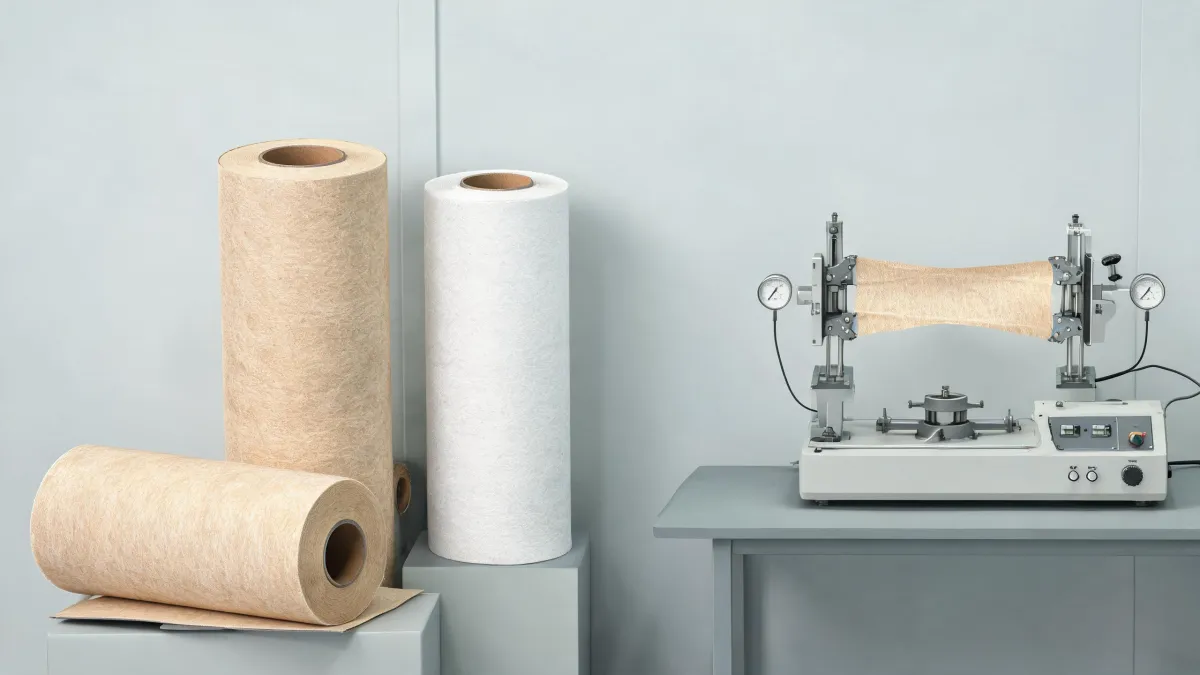
If you're buying bulk PP nonwoven fabric for a medical, filtration, or hygiene product line, the supplier selection shouldn't start with price. It should start with spec tolerance. The single most important thing I've learned from reviewing incoming materials is this: an off-spec nonwoven can wreck your production even when the price looks great. The Ahlstrom 8964 thickness spec, for instance, is exactly the kind of number that seems trivial until a batch arrives 0.05 mm too thick and your assembly line jams.
I'm the quality/compliance manager at a nonwoven converting company. I review every material batch before it goes into production—roughly 200+ unique items per year. In Q1 2024 alone, I rejected 6% of first deliveries for spec drift: basis weight, thickness, or air permeability outside the agreed range. Those rejections cost one vendor a $22,000 redo and cost another a customer relationship that took two years to build. So when I talk about how to choose spunbond nonwoven for wholesale, I'm not comparing datasheets in the abstract. I've seen what happens when the datasheet doesn't match the roll.
The real question: what's the tolerance, not just the nominal spec
Most buyers ask for a material grade and a price per kilogram. They don't ask about measurement method, measurement location, or acceptable deviation. That's a mistake. A supplier can honestly say their spunbond is "120 gsm" while every roll runs 115 gsm at the edges and 132 gsm in the middle. If your process needs consistent absorbency or seal strength, that 10+ percent swing will show up in your finished product.
It's tempting to think that a quoted spec like "Ahlstrom 8964 thickness: 0.45 mm" is a fixed number. But thickness in nonwovens is usually measured under a specific pressure and foot size. Different instruments give different results. I've seen the same roll measure 0.42 mm on one calibrated gauge and 0.48 mm on another. The question you should be asking isn't just "what's the thickness?"—it's "how was it measured, and what's the tolerance?" The Ahlstrom 8964 datasheet gives you the nominal value, but the supplier's quality plan tells you whether they actually hold it.
What I check before approving an SMMS nonwoven OEM supplier
For SMMS nonwoven OEM work, the layer structure is the heart of the product. SMMS stands for spunbond-meltblown-meltblown-spunbond, and the meltblown layer is your barrier. If a supplier quietly reduces the meltblown basis weight from 15 gsm to 10 gsm to save cost, you won't always see it in the total fabric weight. You might see it in a failed liquid penetration test—or worse, in a field failure after the product ships. I always require a layer-by-layer breakdown in writing, plus a sample from the actual production run, not just a lab-made mock-up.
There's a satisfying clarity when a supplier actually commits to that. After years of vague assurances, finally seeing a documented SMMS layer structure—that's the payoff. But it's rare. Many suppliers don't want to disclose layer weights because it exposes their cost structure. If they won't put it in writing, that's a red flag.
Here's something counterintuitive: a thicker nonwoven isn't necessarily stronger. For spunbond, tensile strength depends more on fiber bonding, draw ratio, and polymer grade than on thickness. So when you're specifying Ahlstrom 8964 thickness, you need to know whether you actually need thickness for volume/compression behavior, or whether you're using it as a proxy for strength. If it's strength you need, specify tensile and elongation values directly.
Bulk PP nonwoven fabric: sample vs. production roll
One of the biggest blind spots I see is buyers qualifying a bulk PP nonwoven fabric supplier based on a hand sample. Hand samples are often cut from a carefully selected roll—sometimes even from a different production line. The production roll that shows up at your dock can be a completely different story. In a recent audit, we found that one supplier's production rolls had edge-to-center thickness variation of 20%. The sample they sent was fine. Every bulk roll we tested wasn't.
Honestly, I'm not sure why some suppliers have such large variations between the edges and the center of the roll. My best guess is it's related to how the spin beam and forming wire distribute fibers, but I've never seen a supplier openly document that. What I do know is that if you don't check it, your converting line will discover it for you—usually in the form of jammed equipment or inconsistent sealing.
What to put in your supplier agreement
If I had to narrow down the practical side of how to choose spunbond nonwoven for wholesale, I'd focus on three contract points:
- Measurement standards. Specify test methods (e.g., ISO 9073 for basis weight and thickness) and measurement conditions. Don't let the supplier choose their own method after the fact.
- Lot traceability. Require test data from the actual lot you received, not a generic certificate of analysis. A COA with no batch number isn't worth the paper it's printed on.
- Rejection criteria. Agree on tolerances before the order. Industry norms are roughly ±5% for basis weight and ±10% for thickness, but your product may need tighter control. If your process needs ±3%, say so in the contract.
The "always get three quotes" advice ignores the transaction cost of evaluating three suppliers and the value of a vendor who already knows your spec tolerance. Efficiency is a competitive advantage. The more time I spend chasing spec drift, the less time I have for actually improving quality.
When Ahlstrom-grade consistency isn't worth the premium
Not every application needs Ahlstrom-grade consistency. If you're making disposable shopping bags or simple agricultural ground covers, a cheaper generic spunbond may be perfectly fine. Price matters when the nonwoven isn't a functional layer. But if the material filters, wicks, blocks, or touches a patient—if it's a functional layer—then chasing the lowest bulk PP nonwoven price can become the most expensive decision you make.
Also, don't assume every SMMS nonwoven OEM supplier offers the same customization. Some only produce fixed layer structures, and they'll push you toward whatever they already run. If you need a specific meltblown weight for a filtration requirement, ask the question directly. And don't let a sales rep tell you "we don't disclose layer weights because it's proprietary." In my experience, a legitimate OEM supplier can show you the layer structure under NDA. If they can't, they're probably not a true SMMS OEM—they're a converter who buys SMMS fabric in bulk and slits it.
The best part of finally getting our supplier verification process systematized: no more late-night worry sessions about whether an incoming roll will meet spec. We still get surprises, but now we catch them before they hit the production line. That's the real return on investment.
Bottom line: choose your nonwoven supplier based on spec control, layer transparency, and measurement discipline. Ahlstrom 8964 thickness is a good example of a spec that needs verification, not assumption. Get the tolerance in writing, test the actual lot, and don't let price per kilogram be the deciding factor.