-
What is being compared: Ahlstrom paper and technical nonwovens vs bulk PP nonwoven fabric
-
1. Specification depth: Why someone asks for the Ahlstrom ReliaFlow sample pad datasheet PDF
-
2. Lot-to-lot consistency: This is where quality control earns its keep
-
3. Private-label and OEM flexibility: What does nonwoven fabric private label actually mean?
-
4. Nonwoven fabric wholesale cost: compare cost per conforming metre, not price per kilo
-
What should you approve? A practical ending
Two rolls arrive at the loading dock. Both look white. Both are around 120 cm wide. Both are, at least from a distance, nonwoven fabric. One is an Ahlstrom technical grade with a datasheet you can trace; the other is private-label bulk PP nonwoven at a wholesale price that gets management's attention. Which should your QC team approve?
I am a quality and compliance manager. I review roughly 200 incoming nonwoven products each year and I sign off on materials that eventually go into customer deliveries. I have rejected about 7% of first deliveries this year for incomplete lot tracing. The rolls were not always visibly bad. The problem is that trust me is not a quality plan.
This is not an argument for buying Ahlstrom just because it has a brand. I approve private-label bulk PP nonwoven all the time. It is a comparison framework for deciding when you need a technical specialty grade and when a simpler commodity grade is enough.
What is being compared: Ahlstrom paper and technical nonwovens vs bulk PP nonwoven fabric
Ahlstrom products cover a broad range: paper-like substrates, filtration media, lateral flow sample pads, and several nonwoven types. In B2B purchasing, people often say Ahlstrom paper even when they mean something more technical. That shorthand is risky. One Ahlstrom paper grade can be completely different from another. If you ask a supplier for Ahlstrom paper without a grade code, you have not defined what you need.
At the other end are commodity polypropylene nonwovens, usually sold at a lower price and sometimes packaged under the buyer's own private label. In this article I compare these two options across four dimensions: specification depth, lot-to-lot consistency, OEM and private-label flexibility, and total cost.
1. Specification depth: Why someone asks for the Ahlstrom ReliaFlow sample pad datasheet PDF
When a lateral flow development team contacts me about sample pads, one of the first requests I hear is for the Ahlstrom ReliaFlow sample pad datasheet PDF. They are not collecting files for a library. They need to know basis weight, thickness, wicking behavior, and release characteristics so they can set incoming specifications before they buy.
With a specialty pad, a one-page datasheet with only width and grammage is incomplete. For a diagnostic or filtration component, you need enough data to judge whether the material will perform. If the supplier cannot explain where the numbers come from, the quote cannot be evaluated.
Now look at the other side. A bulk PP nonwoven fabric used for protective sheet, general separation, or packaging may not need sophisticated functional data. A spec that says spunbond polypropylene, 60 gsm, 140 cm wide, and white can be enough. Asking for a sample-pad level of detail for this application is over-engineering. That would cost time without creating value.
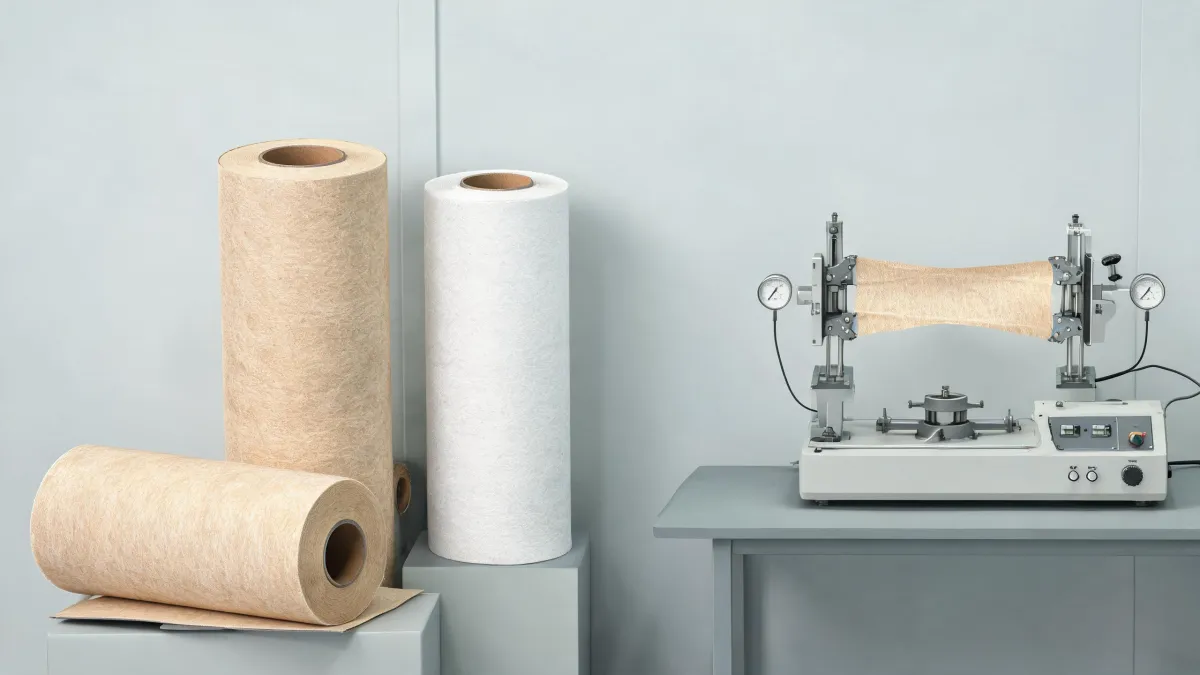
From outside, a roll of bulk PP nonwoven looks almost identical to a specialty Ahlstrom media. The difference is not visible on the shell. It is in the amount of verified data attached to the roll. That becomes obvious when a customer asks how you know the material will work in their process.
Conclusion for this dimension: if the application is functional or regulated, the specialty grade with strong datasheets wins. If the roll is only a structural or barrier layer, a practical datasheet from a private-label supplier can be enough.
2. Lot-to-lot consistency: This is where quality control earns its keep
Consistency matters because production lines react to variation. Basis weight changes can affect die-cutting, sealing, absorbency, and appearance. A small shift that looks minor to an outside inspector can create jams and rejected parts inside a converting line.
Earlier this year I rejected a batch of 8,000 private-label nonwoven sheets. The order sheet said 60 gsm. Our incoming checks showed an average around 52 gsm, with some samples at 49. The supplier called it within normal industry tolerance. But our converting line was set up for 60 gsm. The lighter material caused edge curl and machine stops. After downtime, overtime, and a late customer delivery, that order cost far more than the quote suggested. And the supplier's tolerance did not cover the damage.
Why compare this to Ahlstrom? Specialty nonwoven manufacturers depend on reproducing subtle performance characteristics. They control the process from raw material to finished roll. When you buy a defined Ahlstrom product from the manufacturer or from an authorized distributor, you are buying a reproducible production process, not just a roll.
Bulk PP nonwoven fabric can also be consistent. A converter that runs its own production or tests every received lot can hold a tight range. In that case, private label can be excellent. But if you buy private-label material simply because it is cheaper and assume quality will happen, consistency becomes a gamble. Some bulk fabric is excellent. Other lots can change basis weight between two deliveries without any notification.
Conclusion: consistency follows process control, not the label. A brand can reduce verification work, but a private-label supplier with good process data can also work well.
3. Private-label and OEM flexibility: What does nonwoven fabric private label actually mean?
A frequent search in our industry is nonwoven fabric private label. Many buyers want to put their own brand on a product and manage their own SKUs. The mistake is treating private label only as a commercial arrangement.
For commodity bulk PP nonwoven, private label is relatively simple: a converter produces or imports the fabric, slits it, and packs it under your name. If the application is non-critical and physical properties are simple, this works well.
For technical nonwovens and diagnostic media, private label is not a sticker exercise. The brand owner is accountable for performance. If you private-label a bulk PP nonwoven as a substitute for an Ahlstrom technical pad, you are creating a performance promise that the product may not keep.
A better route for technical material is an OEM arrangement with a manufacturer that can control and document the product. In that context, Ahlstrom or any capable technical manufacturer can support your specification. They will not simply put your label on something. They will produce or qualify materials to an agreed specification and provide data for your own quality file.
Conclusion: private label and OEM are good options, but only when they include a signed quality agreement. Without that, a different label is not a product decision.
4. Nonwoven fabric wholesale cost: compare cost per conforming metre, not price per kilo
If you search for a nonwoven fabric wholesale cost guide, you will find raw material indexes and rough price ranges for spunbond, meltblown, and SMS products. These numbers help with early budgeting. They do not tell you which option to choose.
In my role, I compare cost per conforming metre. That means I take the quoted cost and add the cost of every extra inspection, every rejected metre, every line stoppage, and every customer complaint before I decide.
Suppose the bulk PP nonwoven fabric price looks attractive. If you need to test every roll because the supplier has no traceable data, the low price loses some of its value. If even a small part of the order fails your spec, the remaining cost increases. If material disappears in setup waste, the real price changes. The same logic applies in reverse: paying a premium for Ahlstrom on a low-risk application is waste.
The surprising conclusion is often that branded technical material is not always more expensive in the long run, and private-label commodity material is not always the bargain it seems. But there are also many cases where private label is the right answer, especially if the application does not need the technical headroom.
For a functional application, the difference in material price between Ahlstrom and a private-label substitute may be small compared to the cost of a field failure, a regulatory question, or a lost brand. In a non-critical application, paying an Ahlstrom premium is not necessary. The choice depends on consequences, not just the purchase order total.
What should you approve? A practical ending
The quality-controlled option, in this case Ahlstrom technical material, is the safer choice when you need a published datasheet, like the Ahlstrom ReliaFlow sample pad datasheet PDF, to support an assay, filter, or medical device specification. It is also the safer choice when the cost of variation is high, when process reproducibility directly affects product performance, and when a recognized material simplifies regulatory documentation or customer approval.
The private-label bulk PP nonwoven option works when the application is genuinely low-risk, when the direct product price is the main concern, and when your converter can certify source, test lots, and hold to a written acceptance spec. It also works when you have enough time and volume to qualify a second source.
When I am under time pressure, I default to the material with the most complete data. Sometimes that is Ahlstrom; sometimes it is a private-label product from a converter I already audit. The key is not letting dates overrule specifications.
The strongest position is not brand loyalty and not a low price. It is knowing exactly what the material must do and what failure will cost. Ask that question first. The right side of this comparison becomes obvious.