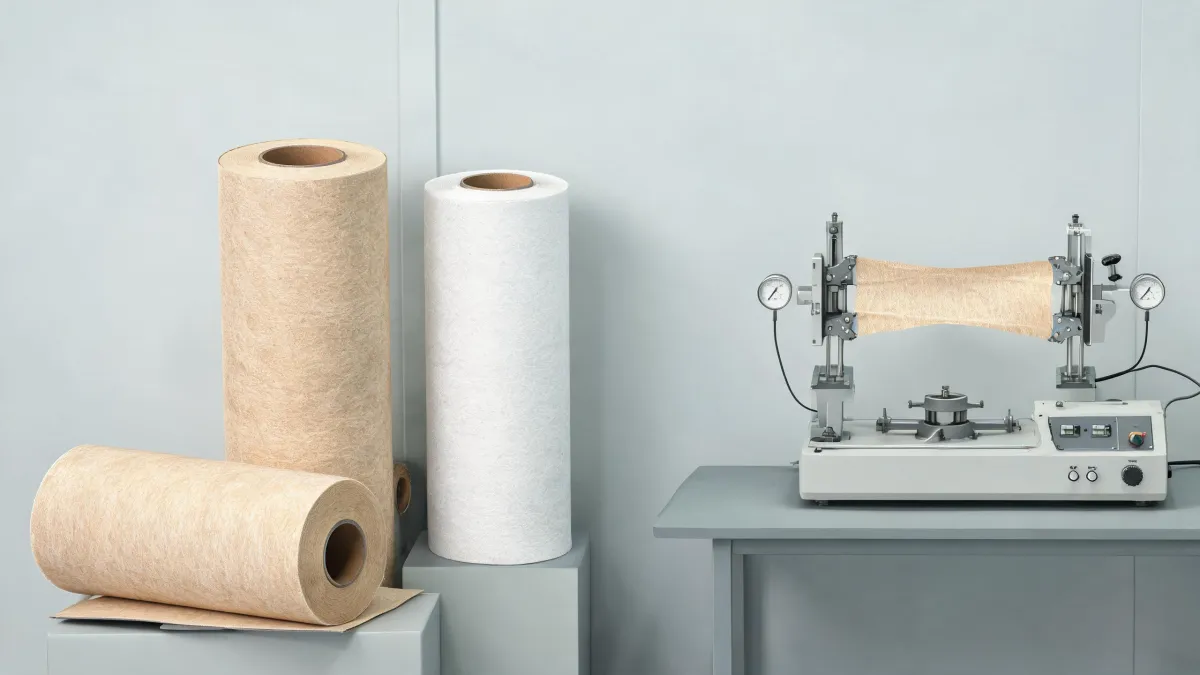
If you've searched for "Ahlstrom paper," you probably weren't looking for office paper. Most people who land on Ahlstrom.com are sourcing technical materials: a filtration medium, a lateral-flow sample pad, a nonwoven fabric for medical or hygiene products. The old paper name stays in search history. The product range moved far beyond it long ago.
The question I get from procurement teams isn't about paper. It's usually a version of this: "We found an unbranded nonwoven that the distributor says is equivalent to Ahlstrom, and the price is noticeably lower. Should we switch?"
That deserves an honest answer. I'm a quality and brand compliance manager at Ahlstrom. I review the documentation that accompanies roughly 240 lots per year—medical nonwovens, filtration media, hygiene materials, and components for diagnostics. In 2024, I rejected about 7% of first-release lots, often because the paperwork didn't match our test results rather than because the material was bad. So my bias is clear: quality starts with traceability.
This article compares two ways of buying the same category of thing:
- Option A – the documented buy. A defined material from a specialty manufacturer or authorized distributor, with a datasheet, lot traceability, and technical support behind it. Ahlstrom is our example, because it's the data I know best.
- Option B – the commodity buy. An unbranded "equivalent" sourced from a wholesaler or trader whose main advantage is a lower price per kilogram.
I'm not going to say Option B is always wrong, because it isn't. But you need to know where the savings actually come from.
Dimension 1: The Documentation Test
In medical, hygiene, filtration, or IVD work, a datasheet is not marketing. It's the technical side of your purchase contract. Without it, you have no objective baseline for a dispute.
Here's a useful test. Search for "ahlstrom reliaflow sample pad datasheet pdf." The datasheet is publicly available. Read how it states values—and the test methods attached to each one. It exists so a device developer can evaluate a pad before making a phone call.
Now ask an unbranded supplier for the equivalent of a ReliaFlow sample pad datasheet. What often arrives is one line: "same as Ahlstrom, good quality." If you're lucky, a photocopied spec sheet with no revision date and no test method.
In our Q1 2024 quality audit, I evaluated eight unbranded sample pads that distributors described as ReliaFlow equivalents. Four arrived without any lot certificate. Two carried copied spec pages from other manufacturers—including an older Ahlstrom sheet. Only two provided complete, current documentation, and one of those then failed its own claimed wicking time in our release test.
The most frustrating part of these audits: the same vague claims come back even after we ask for specific documents. You'd think a written request for "datasheet, certificate of analysis, and lot number" would settle it. It narrows the field, but only barely.
Verdict: If a seller cannot produce a current, manufacturer-issued datasheet with a revision date and test methods, stop comparing. The material might be fine. The process isn't.
Dimension 2: Lot-to-Lot Consistency
Here's where you might expect me to say the unbranded material always fails. It doesn't. I've tested generic sample pads that behaved beautifully. I've tested generic SMS and spunbond fabrics that were, on a single roll, indistinguishable from branded grades. That's exactly why this decision is hard: a single sample proves nothing about the next ten lots.
When we track multiple lots of unbranded "equivalents," a pattern emerges. The averages drift. Some rolls sit at the edge of tolerance; a few fall outside. The mean looks acceptable, but the worst roll is what stops your production line.
In 2024, we audited twelve rolls of a generic SMS labeled 35 gsm. Actual basis weight ranged from roughly 32 to 39 gsm. A trader can honestly say that's within a common range for polypropylene nonwovens. But if you're converting surgical drapes that need barrier performance under EN 13795, a 20% swing in basis weight is not "within range." It's a compliance risk.
Consistency is less exciting than price—and more expensive to ignore. For critical applications, I'll take a material that consistently meets its spec over one that occasionally exceeds it. Predictability. That's the product.
Verdict: If you're buying for continuous production or regulated use, a sample is only the first step. Ask for lot-to-lot data. If the seller has no such history, assume consistency is unproven.
Dimension 3: The Catalog is Only as Good as Its Specs
"PP nonwoven fabric catalog" is one of the most common search phrases in this industry. But a catalog is not the same as a price list. A real product catalog states polymer type, basis weight tolerance, width tolerance, roll length, and the test method behind each number. A price list gives you a product name and a photo.
Ahlstrom's catalog spans medical and hygiene nonwovens, filtration media, and fiber-based materials for diagnostics and industry. That breadth has an operational advantage: a manufacturer can qualify one supplier's documentation system and apply it across several product lines. And when buyers still type "Ahlstrom paper," many are looking for a material that behaves like paper but performs like an engineered substrate. That's not nostalgia; it's a specification.
If you're a distributor, add one line to your own SMS nonwoven distributor buying guide: no lot certificate, no order. It sounds strict. It should be. A broker can quote SMS in 30, 40, or 80 gsm all day, but if he can't provide polymer type, bonding process, or a certificate of analysis, he is not selling data—he is selling a guess at your risk.
Verdict: For informal, one-off buying, a price list is enough. For anything that must be reproduced, only a documented catalog supports you.
Dimension 4: The Cost That Doesn't Appear on the Quote
Let's address the obvious. Unbranded material can look 10–20% cheaper than the Ahlstrom quote. In a teardown I ran in 2024, five commodity alternatives did offer real per-kg savings. But after incoming inspection, quarantine, retesting, and documentation review, most of that advantage had evaporated.
Material cost shows up in procurement's spreadsheet. The cost of failure shows up later—in production yields, returned goods, and audits. A cheaper sample pad might save €0.02 per rapid test. If one lot causes a line stoppage or a wicking failure, that two-cent gain disappears inside a single rejected batch. We've seen it happen more than once.
There's a perception layer too. When a medical nonwoven, a filter, or a diagnostic device fails in the field, the customer doesn't blame the raw material supplier. They blame the brand on the box. If you're a converter or device maker, material quality is brand quality. That's not a slogan; it's how complaint calls work.
I have mixed feelings about generic materials. Part of me wants to say "buy documented materials," because my job depends on it. Another part knows that for some applications, an unbranded roll is perfectly adequate. The reconciliation is simple: match the material to the actual risk.
Verdict: A lower quote only counts if the material works consistently in your process and supports the claims on your finished product. The cheapest input is frequently the most expensive purchase.
So Which Should You Choose?
My experience is based on quality audits of medical, hygiene, filtration, and IVD materials, plus about four years of reviewing alternative "equivalent" products. If you're sourcing industrial nonwovens for agriculture, construction, or simple packaging, the balance shifts further toward Option B. The dimensions stay the same; the weights change.
Choose Option A—Ahlstrom or an equally documented specialty manufacturer—if any of these apply:
- Your product is regulated or audited: medical devices, IVD components, pharma filtration, or anything that touches skin or serves as a barrier. Standards like ISO 10993 and EN 13795 will demand evidence.
- You're buying medical nonwoven wholesale and want OEM/private label support, application guidance, and consistent technical data over years.
- Your production line runs continuously, where even small material variances cause stops.
- Your brand, not your supplier's, goes on the finished package.
Choose Option B—the unbranded trader—if:
- Your application is non-critical: no barrier claim, no skin or medical contact, no diagnostic function.
- You're covering a short-term gap and can inspect incoming material before it reaches production.
- You understand the exact spec, and you have a backup supplier if the first one disappoints.
Notice what I didn't list: "choose Option B if you want to save money." Saving money on a non-critical product is legitimate. "Saving" money on a critical product usually just moves risk to a later budget.
If I'm making the call, I'd rather explain why a material costs a little more than why a finished product failed. The price difference is counted once. Reputation is counted on every order.
Note: Standards referenced in this article—EN 13795 and ISO 10993—are for general orientation. Verify current versions and applicability for your product and target market. Product availability and specifications change; confirm current technical data on Ahlstrom.com or through an authorized Ahlstrom distributor.